Launch offer — valid today only

📄 Digital book in PDF · read it on your phone or print it

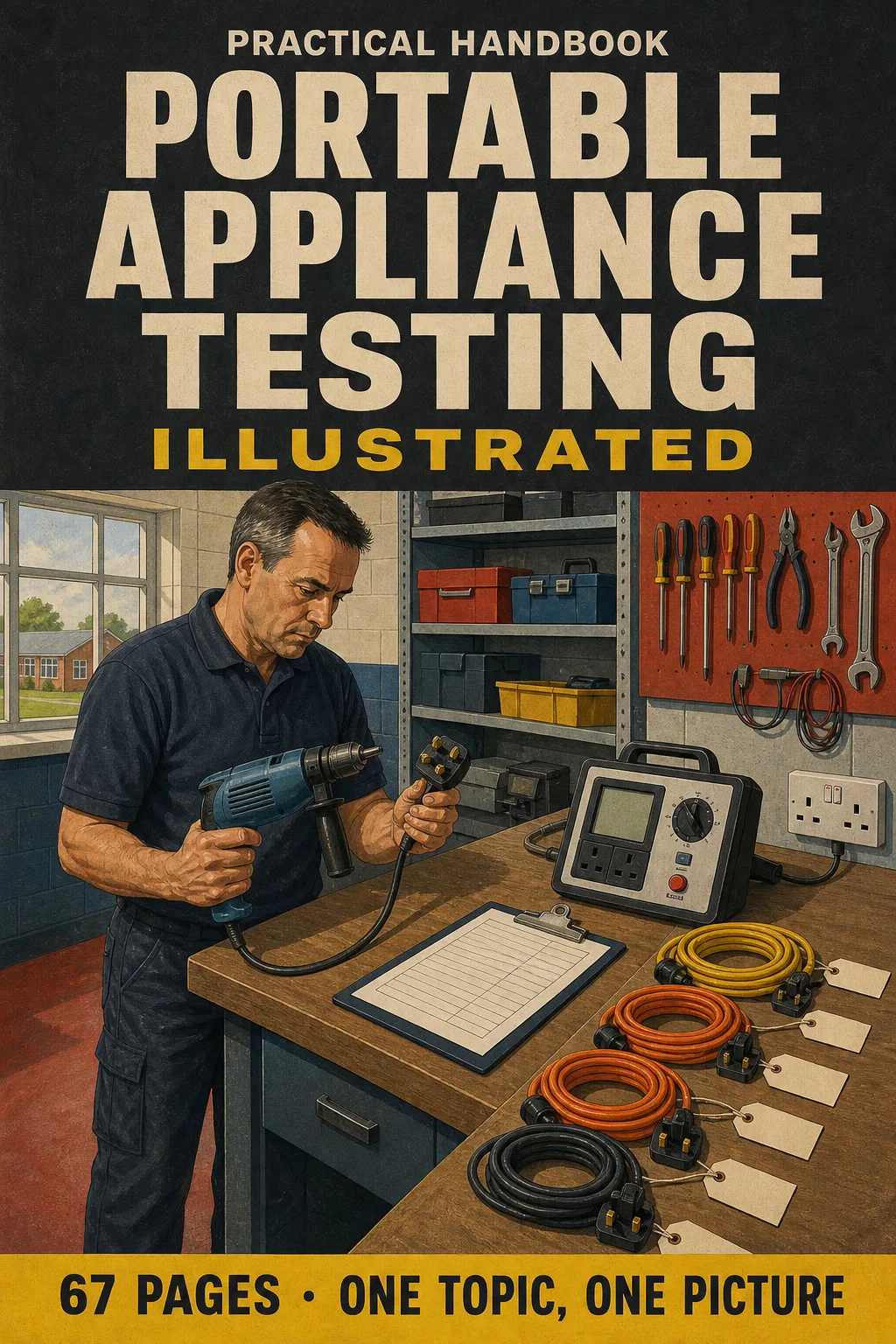
Portable Appliance Testing in Ireland, in Drawings Every Check in the Same Order

Class I, II and III, the visual inspection, your tester, earth continuity, insulation resistance, leakage, portable RCDs, the fail flow chart and the asset register. Every topic has its own page: the drawing first, then what you need to remember. 67 illustrated pages.

START TESTING THIS WAY

🔒 Secure checkout · PDF by email · 30-day guarantee

Every topic, its own pageEach check drawn, with the explanation alongside
67 illustrated pages9 parts, from what Irish law asks for to the whole route on one page
Up-to-date sourcesGeneral Application Regulations 2007, HSA guidance and I.S. EN 50699
PDF by emailFormat

Look Inside the Book

Every page has one large drawing and a box with the values, rules and steps you need to know:

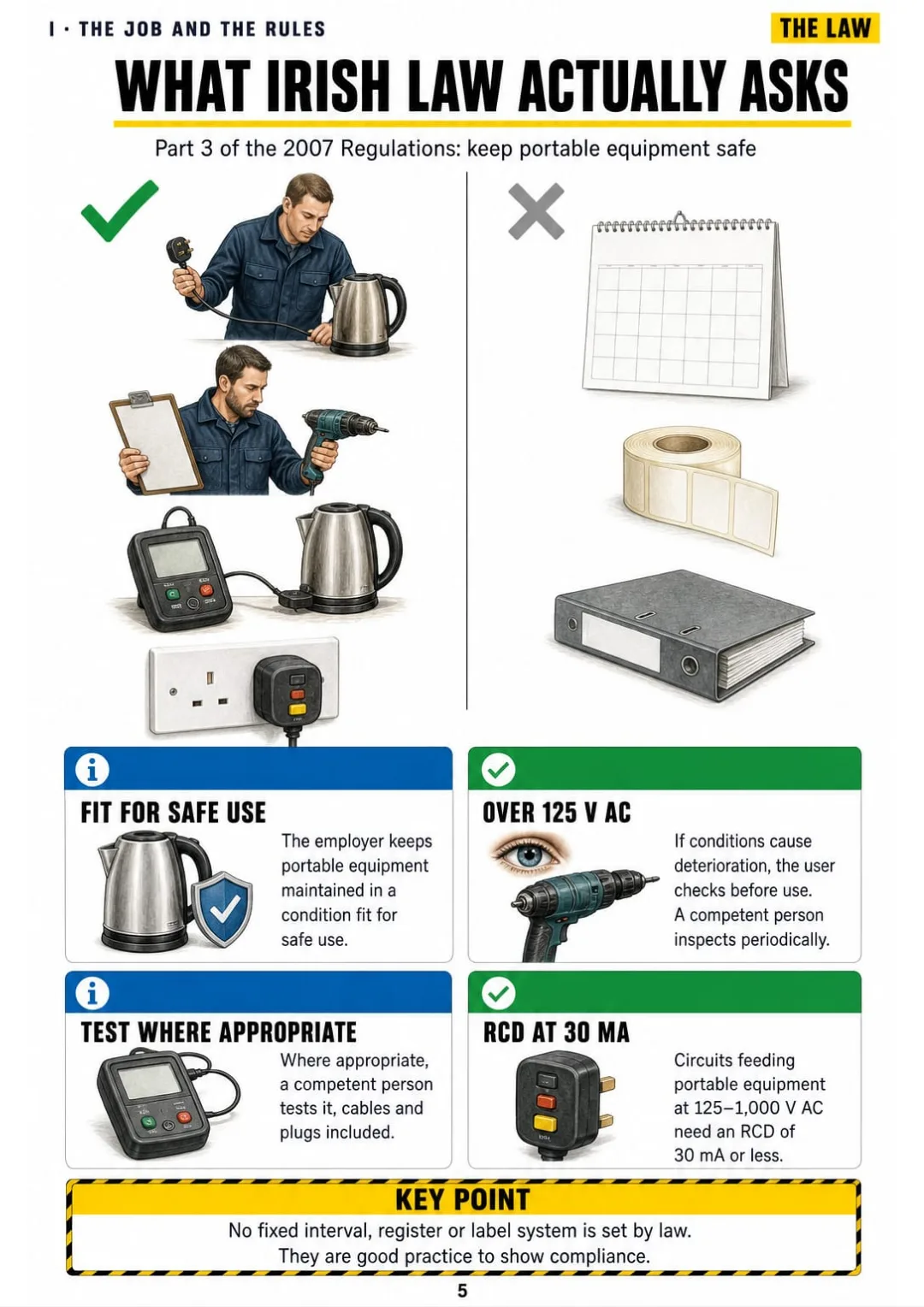
Reg. 81 in one page: what is required, and what is only good practice
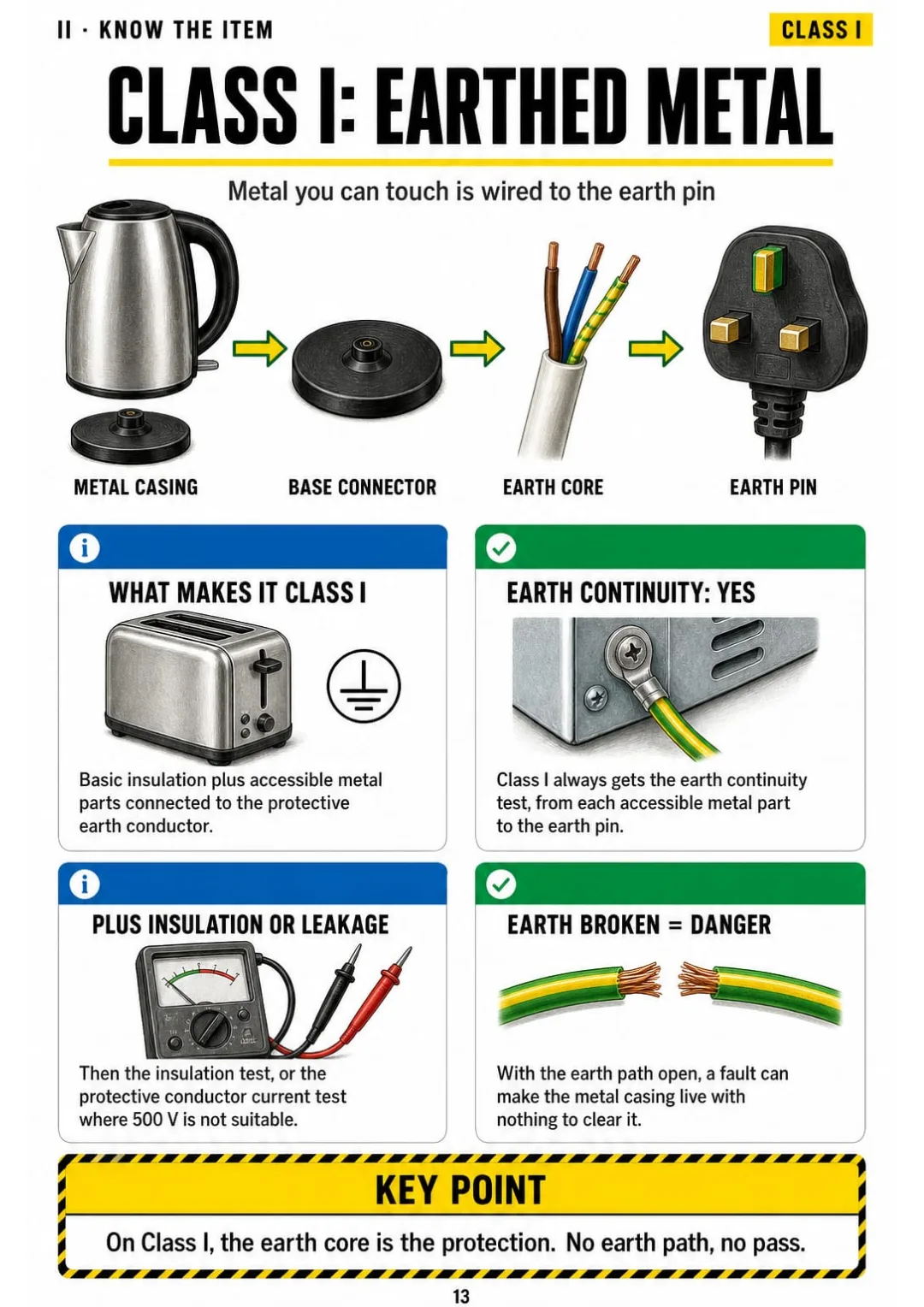
Class I: casing → earth core → earth pin, tested with earth continuity plus insulation or leakage.
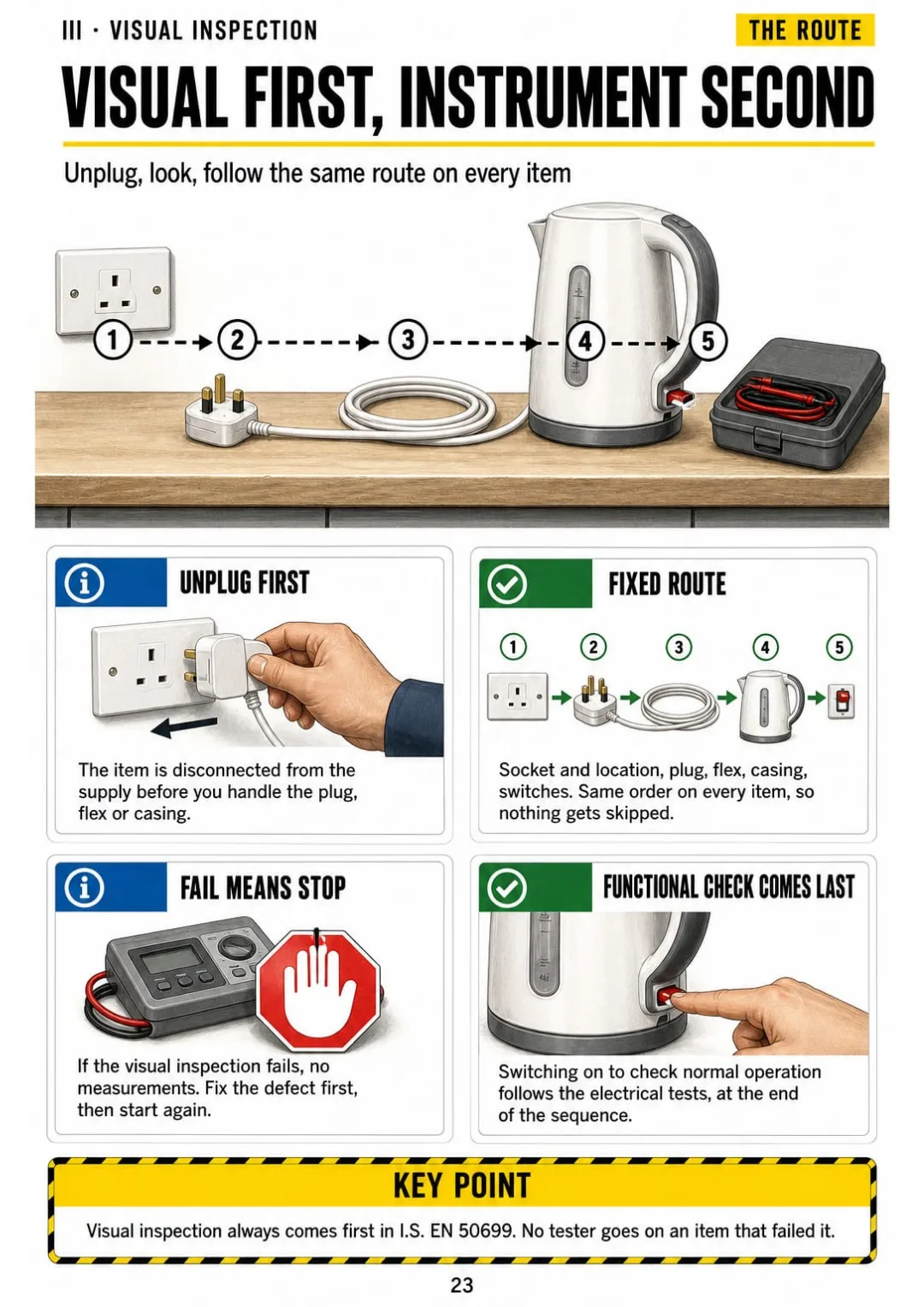
Visual inspection first, same route every item: socket, plug, flex, casing, switches.
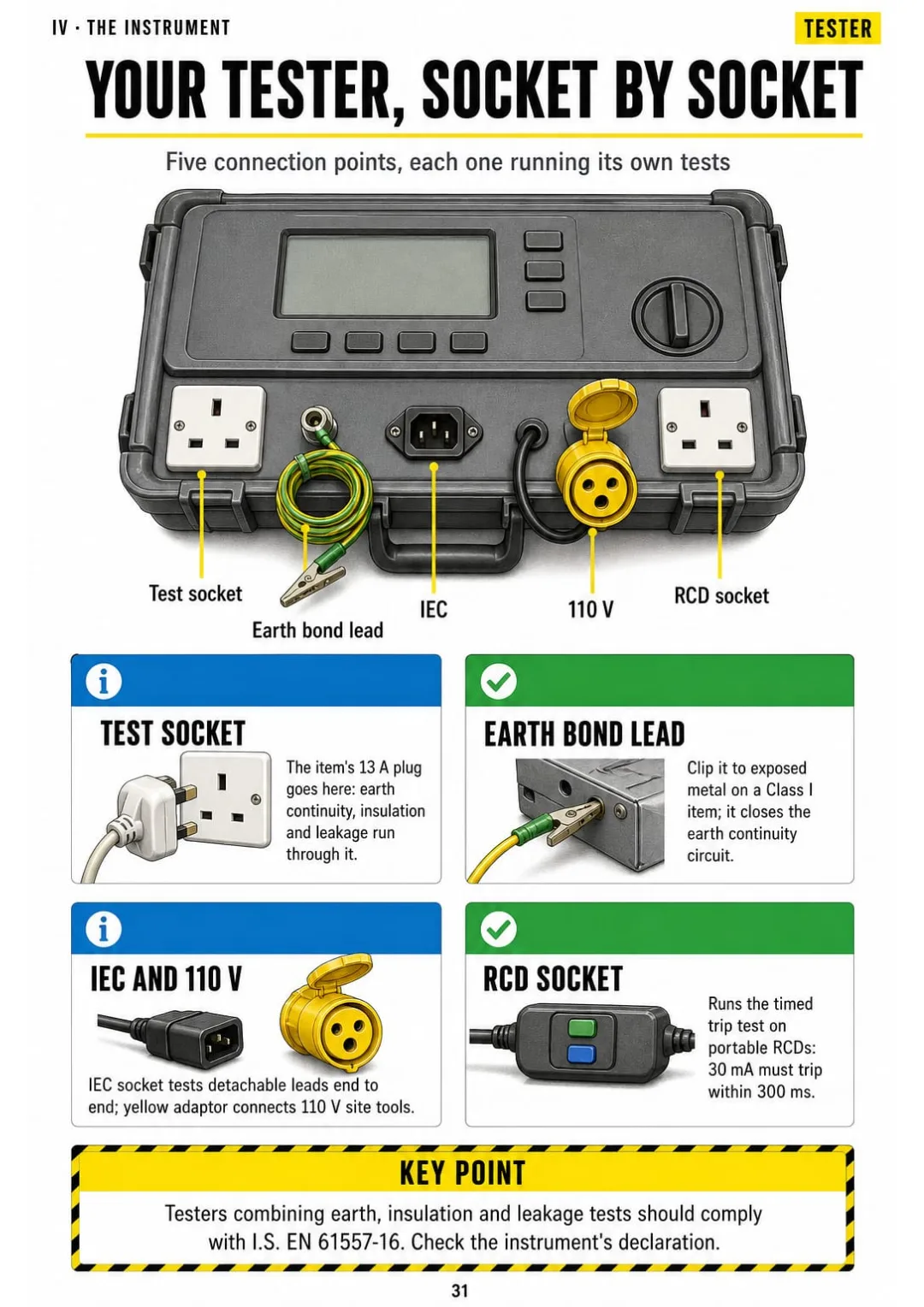
Test socket, earth bond, IEC, 110 V and RCD: each part, its tests
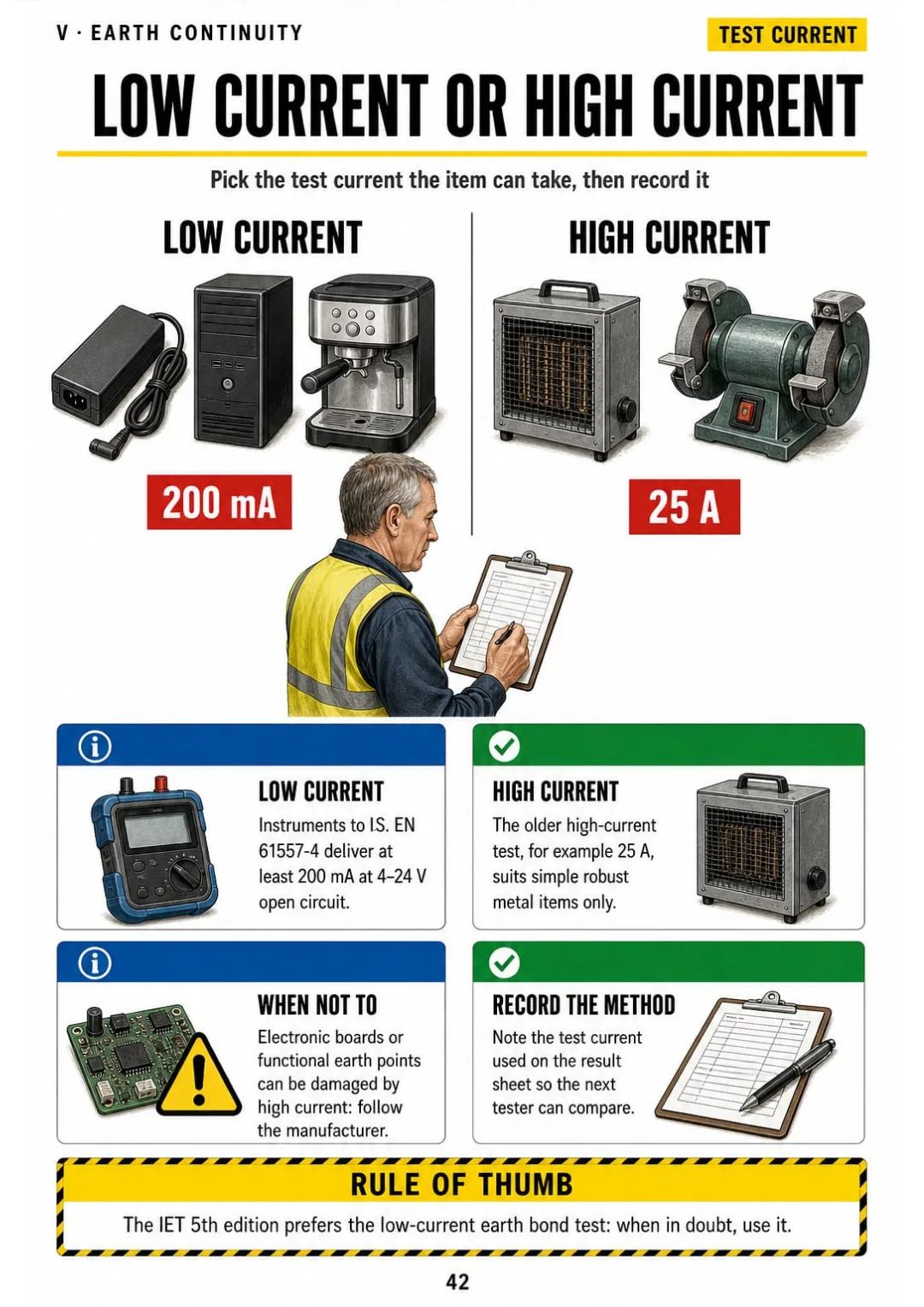
At least 200 mA for electronics; high current only where the item can take it.
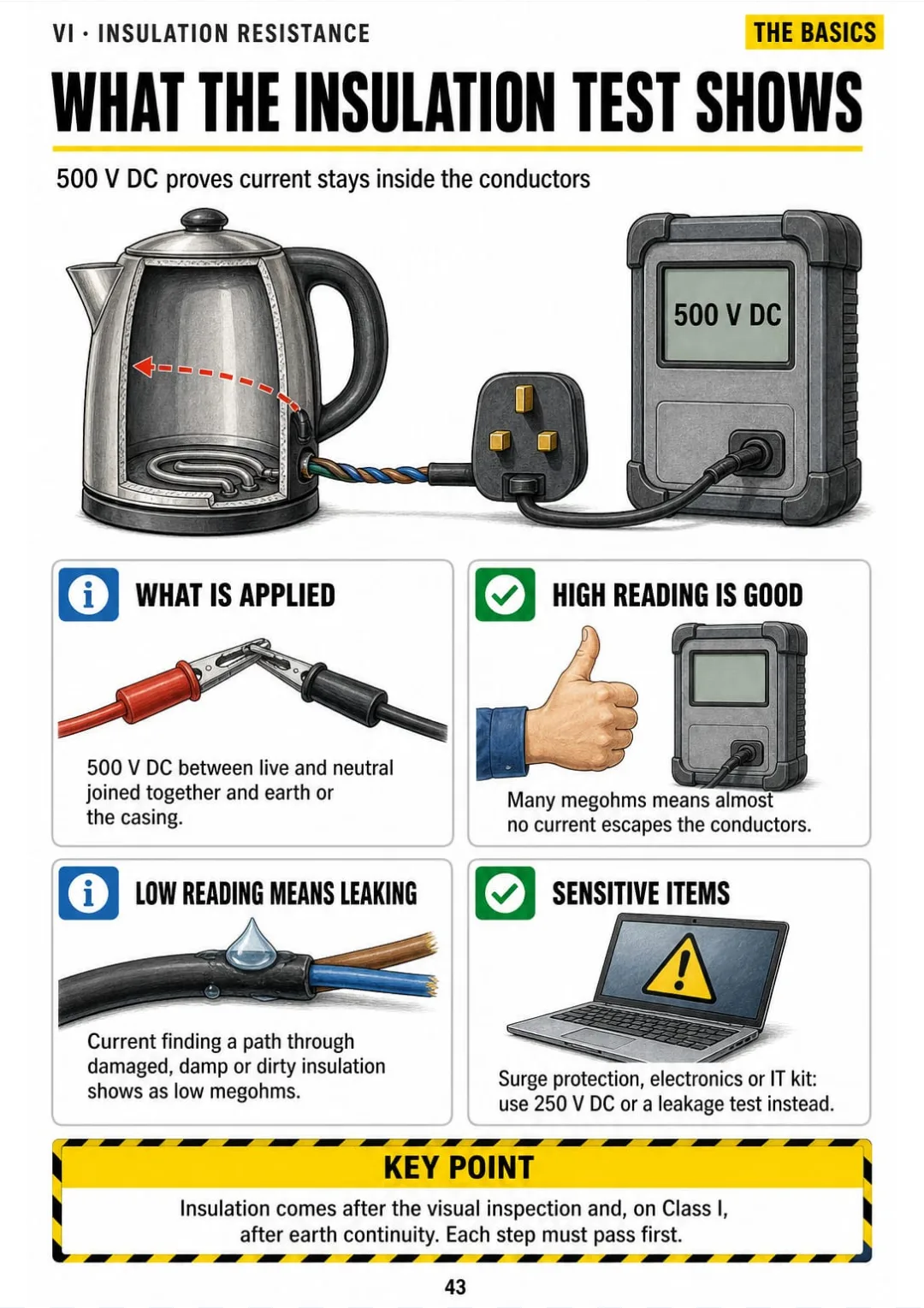
500 V DC from L+N joined to earth or casing: high megohms means no leak path.
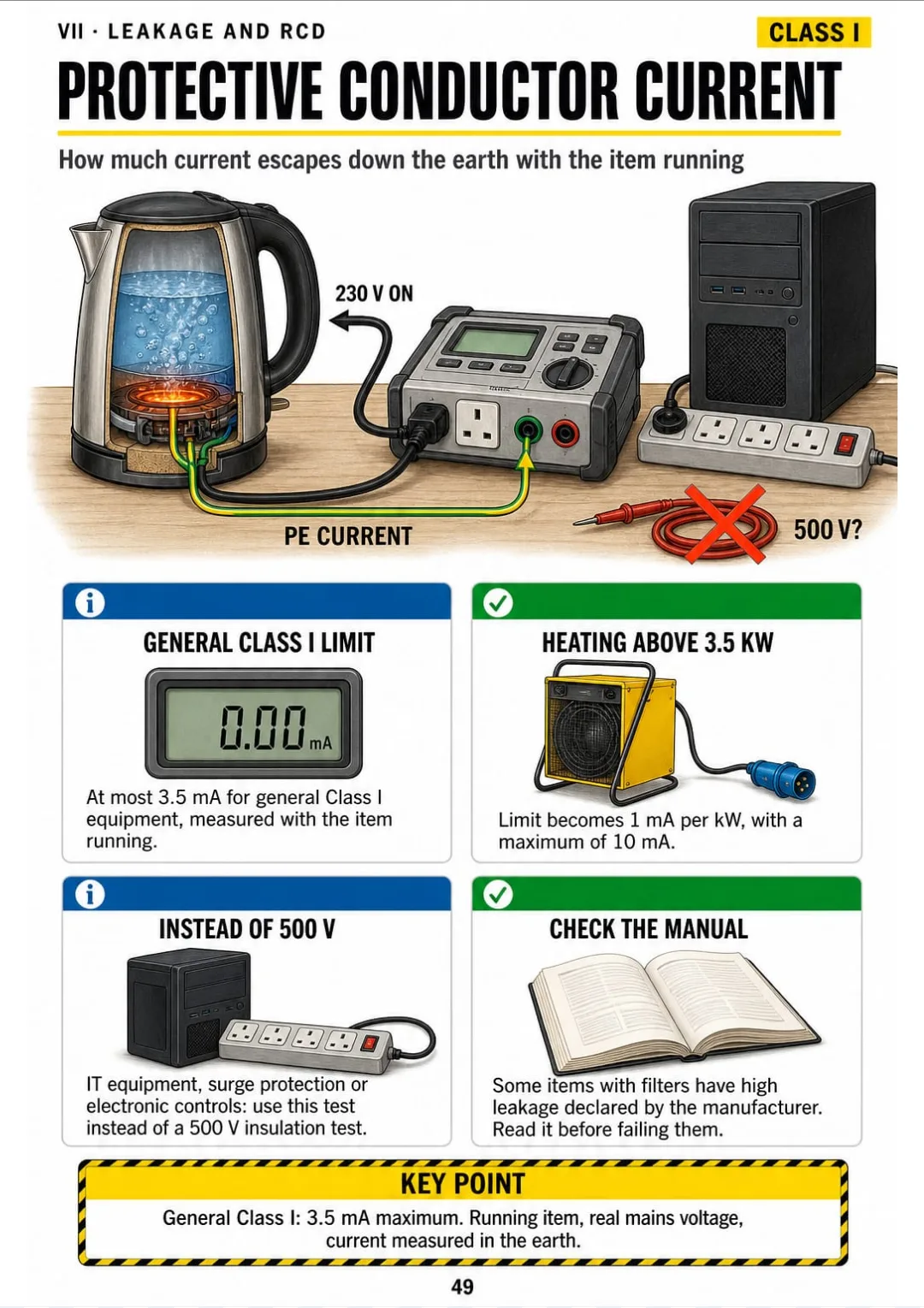
Protective conductor current: 3.5 mA for general Class I; 1 mA/kW, max 10 mA, above 3.5 kW heating.
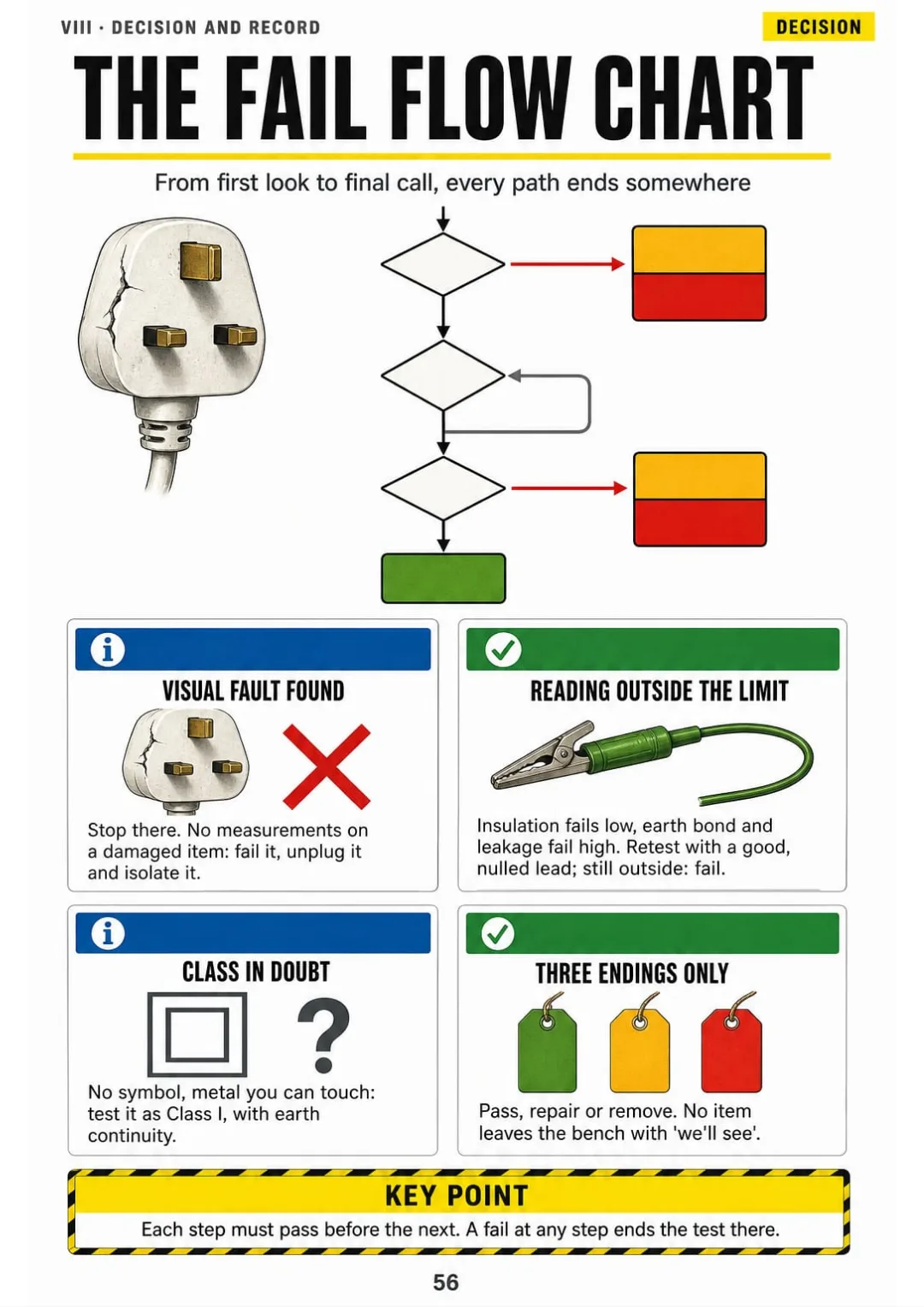
Visual fault: fail and isolate. Class in doubt: treat as Class I. Outside the limit: retest, then fail.

Swipe to see more →

These are real pages from the book. The table of contents is the full one: 9 parts and 63 topics.

The Problem Isn't You. It's How It Was Explained to You.

You're in a school staffroom with a kettle, a toaster and three extension leads on the table, and the tester is already plugged in. You reach for the probes before you've really looked at the plug.

The guidance does say visual inspection comes first. But it says so across four paragraphs, with a list of things to look for in no particular order. So on the day, there's no route in your head, and a cracked plug or a scorched socket gets past you.

Visual inspection first, same route every item: socket, plug, flex, casing, switches.

In this book, visual inspection is one page. The drawing follows the same route on every item: socket, plug, flex, casing, switches, and shows what a fault looks like at each stop. The instrument comes second.

Every other step has its own page too: Class I and Class II, earth continuity, insulation resistance, protective conductor current and the fail flow chart.

You see the route, you follow it, and you don't have to go back to the guidance halfway through the third kettle.

COMPARE FOR YOURSELF

The Same Topic, Two Ways to Learn It

THIS
  • The guidance: line after line
  • Earthing and test paths explained only in words
  • You turn up to the job still unsure
Where equipment is of a construction in which protection against electric shock is provided by basic insulation together with the connection of exposed metalwork to the protective conductor of the supply, the continuity of that conductor between the earth contact of the plug and each accessible metal part should be confirmed by measurement, and the value obtained should be considered having regard to the length and cross-sectional area of the flexible cable, before proceeding, where appropriate, to the measurement of insulation resistance between the live conductors connected together and the protective conductor.
FOR THIS
  • Class I in one drawing
  • The test sequence in a box
  • You see it and it makes sense
Class I: casing → earth core → earth pin, tested with earth continuity plus insulation or leakage.
CONTENTS

Take a Look at the 9 Parts and 63 Topics

The job and the rules in Ireland, knowing the item, the visual inspection, the instrument and set-up, earth continuity, insulation resistance, leakage and RCD checks, decision and records, and the job itself: 67 pages, all illustrated

IThe Job and the Rules in Ireland · pp. 5-12
  1. What the Law in Ireland Actually Asks For
  2. Who Can Do the Testing: Competence, Not a Card
  3. Three Levels of Checking
  4. Hand-held, Portable, Movable, Stationary, Fixed
  5. How Often: Building a Risk-Based Interval
  6. Building Sites: 110 V and the Construction Regulations
  7. The Same Order, Every Item
  8. Before You Start: Agree Scope With the Client
IIKnow the Item Before You Test It · pp. 13-22
  1. Class I: Earthed Metal
  2. Class II: Double Insulated, the Square in a Square
  3. Class III and SELV: Low Voltage From a Safe Source
  4. When You Can't Tell the Class
  5. Reading the Rating Plate
  6. The 13 A Plug Opened Up
  7. Fuses: 3 A, 5 A and 13 A
  8. Flex Types and Sizes
  9. Extension Leads, Reels and Multi-way Adaptors
  10. IEC Leads and Detachable Cords
IIIThe Visual Inspection · pp. 23-30
  1. Visual First: Most Faults Are Seen, Not Measured
  2. Plug Outside: Cracks, Burns and Pins
  3. Plug Inside: Open It When Rewirable
  4. The Flex From End to End
  5. Casing, Guards and Switches
  6. Where and How It Is Used
  7. Signs of Overheating
  8. Visual Inspection Only: When It Is Enough
IVThe Instrument and Set-up · pp. 31-36
  1. Your Tester: What Each Socket and Lead Does
  2. Checking the Instrument Before the Day
  3. Nulling the Earth Bond Lead
  4. Choosing the Right Test for the Class
  5. Items You Must Not Insulation-Test at 500 V
  6. Safety While You Test
VEarth Continuity · pp. 37-42
  1. What Earth Continuity Proves
  2. The Limit: 0.1 Ω Plus the Flex
  3. Working Out Flex Resistance
  4. Flex Test: Bend It While You Measure
  5. Several Metal Parts: Test Each One
  6. Low Current or High Current Test
VIInsulation Resistance · pp. 43-48
  1. What the Insulation Test Shows
  2. The Minimum Values by Class
  3. Class II: Probe the Casing
  4. Switch On Before You Test
  5. Damp, Dust and Heating Elements
  6. Worked Examples: Reading the Megohms
VIILeakage, Polarity and RCD Checks · pp. 49-55
  1. Protective Conductor Current
  2. Touch Current on Class II
  3. Substitute Leakage: The Safe Alternative
  4. Polarity on Extension Leads and IEC Leads
  5. Portable RCDs: The Test Button and the Timed Test
  6. 110 V Site Transformers and Tools
  7. Functional Check: Does It Work As It Should
VIIIDecision, Label and Record · pp. 56-61
  1. The Fail Flow Chart
  2. What to Do With a Failed Item
  3. Pass Labels and Fail Labels
  4. The Asset Register
  5. The Test Result Sheet
  6. After a Repair or a Plug Change
IXOn the Job: Review and Frequent Mistakes · pp. 62-67
  1. Frequent Mistakes on the Earth Bond
  2. Frequent Mistakes on Insulation and Leakage
  3. Frequent Mistakes With Labels and Records
  4. A Day's Testing: Office of 80 Items
  5. Kitchens, Schools and Sites: What Changes
  6. The Whole Route on One Page

One Page, One Topic, All Clear

Think of it this way:

You're testing a hotel kitchen's equipment and a stainless steel kettle gives an earth reading you didn't expect. The chef wants it back, and you have to make the call.

You open the earth continuity page and see it drawn: earth pin to metal case, the path measured in ohms, and the limit with the flex added on, right next to how to bend the flex while you measure.

At least 200 mA for electronics; high current only where the item can take it.

It's the same with Class II and its square in a square, the 500 V insulation test, protective conductor current, portable RCDs and 110 V site transformers. Each one has its own page.

Portable Appliance Testing Illustrated is 9 parts and 63 topics, all drawn, and it finishes with the frequent mistakes, a full day's testing in an office of 80 items and the whole route on one page.

What you see drawn, you don't have to memorize.

What's Inside Portable Appliance Testing Illustrated:

Ipp. 5-12

The Job and the Rules in Ireland

You know what Irish law actually asks of you and what's only good practice: who can do the testing, the three levels of checking, types of equipment, risk-based intervals, 110 V on building sites and agreeing scope with the client.

IIpp. 13-22

Know the Item Before You Test It

Class I, Class II and Class III drawn with their symbols, what to do when you can't tell the class, the rating plate, the 13 A plug opened up, fuses, flex types, extension leads and IEC leads.

IIIpp. 23-30

The Visual Inspection

Why visual comes first, the plug outside and inside, the flex end to end, casing, guards and switches, the environment, signs of overheating and when a visual check is enough.

IVpp. 31-36

The Instrument and Set-up

Your tester socket by socket, checking the instrument, nulling the earth bond lead, matching the test to the class, items you must not test at 500 V and safety while you test.

Vpp. 37-42

Earth Continuity

You stop failing good items and passing bad ones on the earth bond: what continuity proves, the limit with the flex added, working out flex resistance, the bend test, several metal parts and low or high current.

VIpp. 43-48

Insulation Resistance

What the insulation test shows, minimum values by class, probing a Class II casing, switching on first, damp and heating elements, and worked examples in megohms.

VIIpp. 49-55

Leakage, Polarity and RCD Checks

Protective conductor current, touch current, substitute leakage, polarity on leads, portable RCDs, 110 V site transformers and the functional check.

VIIIpp. 56-61

Decision, Label and Record

The fail flow chart, what to do with a failed item, pass and fail labels, the asset register, the test result sheet and testing after a repair.

IXpp. 62-67

On the Job: Review and Frequent Mistakes

Frequent mistakes on the earth bond, insulation, labels and records, a day's testing in an 80-item office, kitchens, schools and sites, and the whole route on one page.

At the end of the book: Worked examples, the frequent mistakes, a full 80-item test day and the whole route on one page.
Plus: 2 Free Books

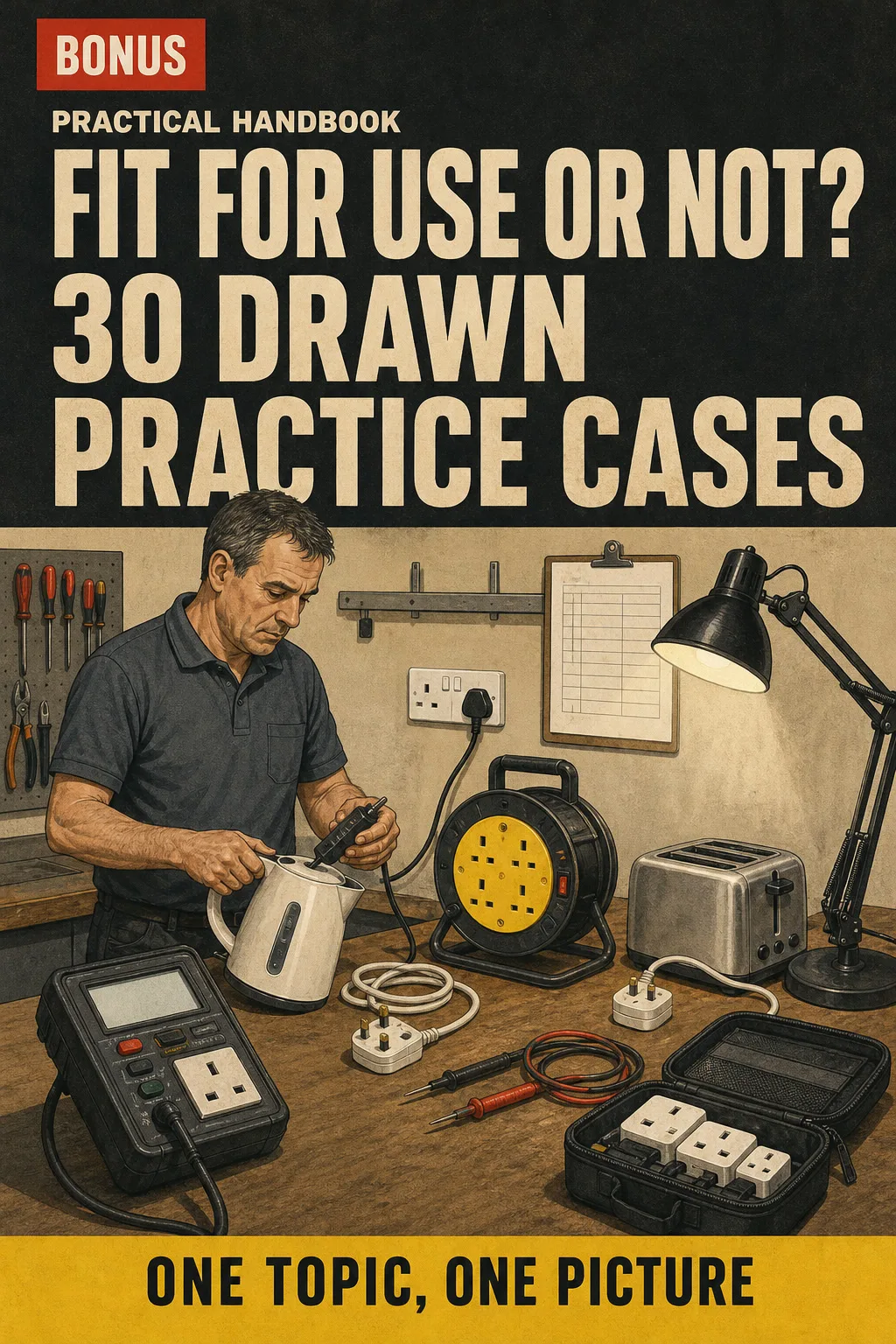
Fit for Use or Not? 30 Drawn Practice Cases

BONUS 1: «Fit for Use or Not? 30 Drawn Practice Cases»

Value on its own: US$ 17.90

Look at the item, the reading and the damage, make your call, then check the answer and the reason on the next page, so the decision feels routine on the job.

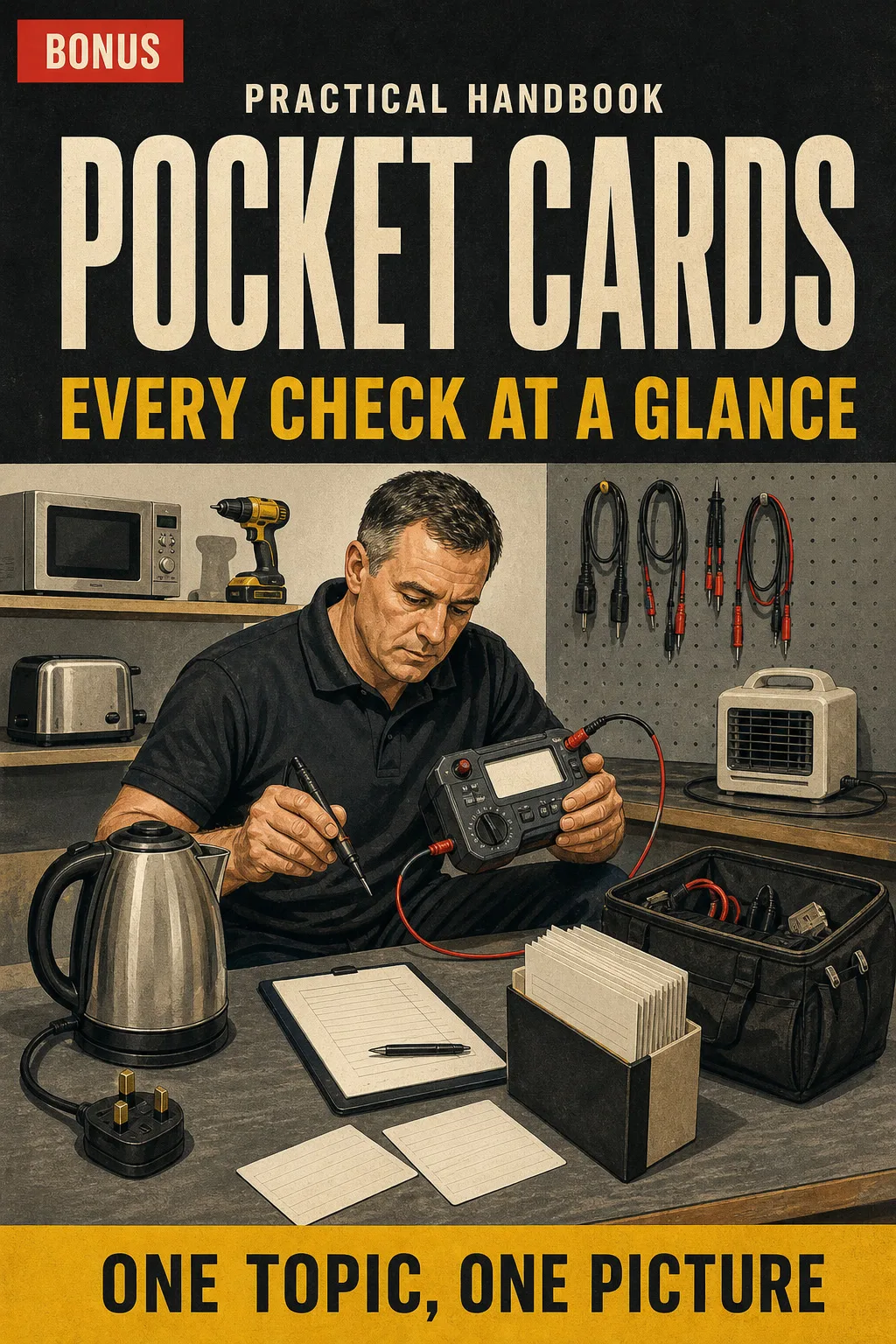
Pocket Cards: Every Check at a Glance

BONUS 2: «Pocket Cards: Every Check at a Glance»

Value on its own: US$ 14.90

The test order, the visual checks and the fail flow chart on small printable cards to keep in the van or the toolbox.

Portable Appliance Testing Illustrated with 2 Free Books

  • Portable Appliance Testing Illustrated: 67 illustrated pagesUS$ 63
  • BONUS 1: Fit for Use or Not? 30 Drawn Practice CasesUS$ 17.90
  • BONUS 2: Pocket Cards: Every Check at a GlanceUS$ 14.90
  • High-resolution PDF to printIncluded
Total value US$ 95.80
YOUR PRICE:
US$ 27
You save US$ 68.80
YES, I WANT PORTABLE APPLIANCE TESTING ILLUSTRATED FOR US$ 27

📄 This is a digital PDF book sent to your email: nothing is printed or shipped.

Secure purchaseEncrypted payment30-day guarantee

PDF by email: We email you Portable Appliance Testing Illustrated as a PDF, together with the two free books. It's a single payment: no installments, no extra charges.

Who This Book Is For

You've just been asked to do the testing

You've just been asked to do the testing

You get the whole job in order, from identifying the class to filling in the register, one page at a time, without wading through the guidance.

Your first big test day is coming

Your first big test day is coming

You go in with the route clear: what to look at, which test goes with each class, what reading to expect and what to do when it doesn't come out right.

You already test for a living

You already test for a living

You get a reference to keep in the van: the limits, the fail flow chart and the frequent mistakes, so you can check yourself when a reading looks odd.

Everything You Get Today

US$ 95.80US$ 27
YES, I WANT PORTABLE APPLIANCE TESTING ILLUSTRATED FOR US$ 27

📄 This is a digital PDF book sent to your email: nothing is printed or shipped.

30DAYS
GUARANTEE

30-Day Guarantee

Try Portable Appliance Testing Illustrated for 30 days, bonus books included.

We refund everything if the file won't open, if the book isn't what you see here, if you were charged twice or if the email doesn't arrive. Just email us.

You pay once. No subscriptions.

Frequently Asked Questions

Is it for me if I already do the testing, or have only just been asked to?

Yes. It's written for electricians and caretakers in Ireland who do the job or are about to. It doesn't explain what a plug is: it goes straight to the checks, the readings and the decisions.

Where does the content come from?

The rules, values and intervals are checked against the current editions of the Irish requirements: the General Application Regulations 2007 (Part 3), HSA guidance on portable equipment, the Construction Regulations 2013 for sites, and I.S. EN 50699 published by NSAI. Where Irish practice matches the UK (the 13 A plug, 110 V on sites), the book says so; where it differs, it follows the Irish rule.

Is this official material?

No. It's an independent illustrated book. It names the Irish rules to explain what it covers, but it isn't issued, approved or endorsed by the HSA, NSAI or any other body.

Does it replace a training course?

No. It's reference and revision material, and it doesn't give you a certificate or a qualification. It doesn't replace proper training, the competence your employer requires or the instructions for your tester.

Does it work with my tester?

Yes, whatever the make. It explains the tests and sockets most PAT testers share: earth bond, insulation, protective conductor current, the IEC lead test, 110 V and the RCD check. Buttons and menus differ from model to model, so for those always follow your tester's manual.

When and how does it arrive?

The book and the 2 bonus books arrive as PDFs by email, to the address you enter at checkout.

Do I have to pay every month?

No. It's a single payment. There's no subscription.

Can I have it on paper?

Yes. The PDFs are laid out to print, so you can keep a copy in the van or the toolbox.

How does the refund work?

You have 30 days. We refund everything if the file won't open, if the book isn't what you see on this page, if you were charged twice or if the email doesn't arrive: just email us.

Before You Close This Page

No more rereading guidance that won't stick.

The earth bond, the insulation test, the fail flow chart: you see them drawn, and that's it.

You turn up to every job knowing where each check is.

Drawings make studying faster.

The book is right below.

One-time payment: US$ 27 · Guarantee: 30 days · PDF by email

YES, I WANT PORTABLE APPLIANCE TESTING ILLUSTRATED FOR US$ 27

📄 This is a digital PDF book sent to your email: nothing is printed or shipped.